Event Types
Choose an Event Type, set the Event Added date and the Location, and optionally add About text and a file.
- Model-level events apply to all batches under that model.
- Batch-level events apply only to the selected batch (and its items, if DPP per item is enabled).
There are three kinds of events in DPP Manager:
EPCIS events– predefined, standards-aligned events (Created, In transit, Sold, Recycled, etc.) that automatically map to GS1 EPCIS 2.0 fields in the background. Some event types show conditional source and destination fields when required.Custom events– organisation-specific events you define (for example, “Displayed at trade fair”) with rich text, images, and documents.Memories– end-user-created events that share the same structure as custom events but cannot be edited by managers. Managers can only hide or show them. When you hide a memory, you can notify the person who posted it.
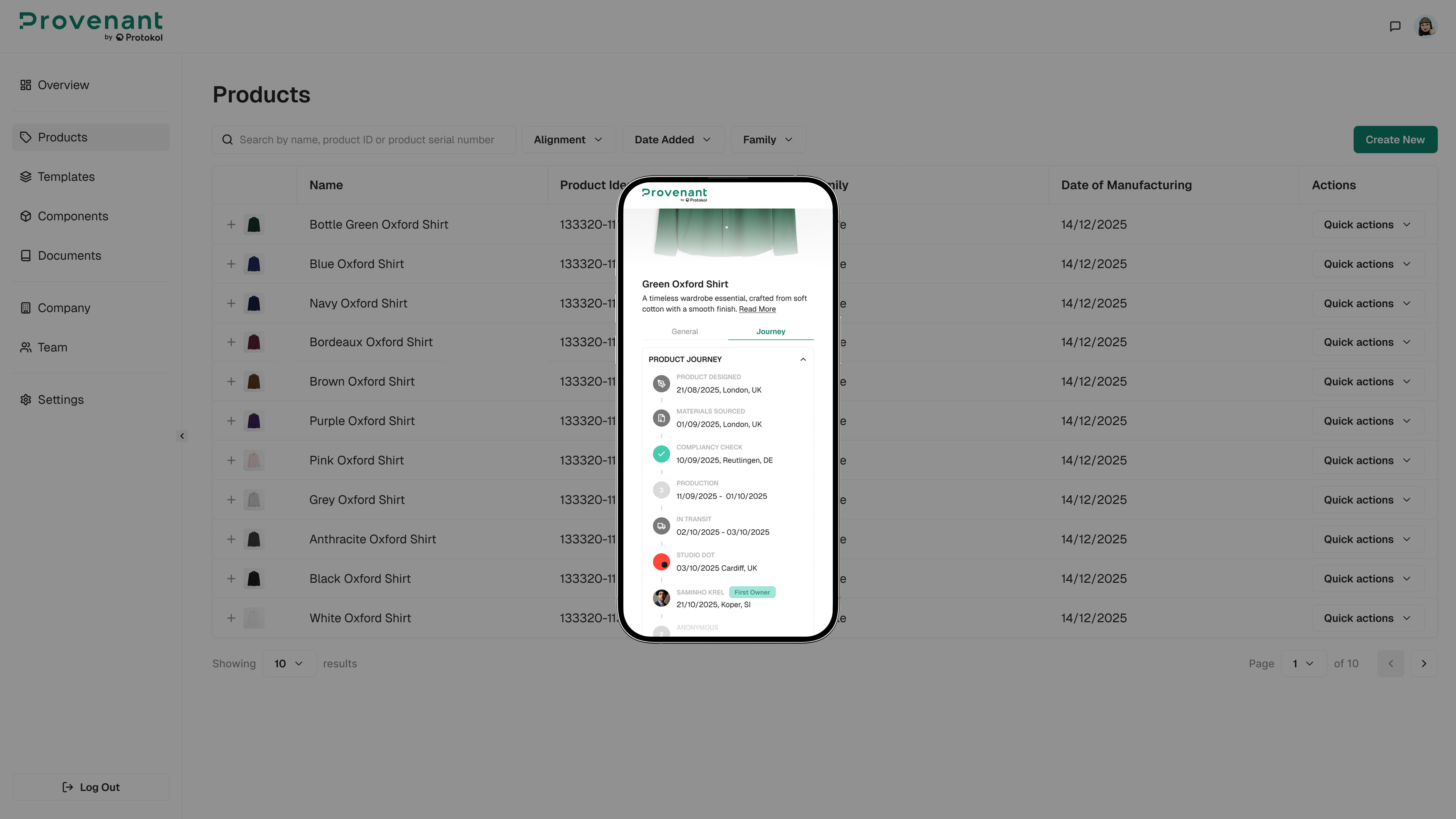
EPCIS event types
| Event type | When to use | Visible in DPP | Notes |
|---|---|---|---|
| Product Created | When the product or batch is first created/commissioned in the system | ✅ | Use for the first lifecycle step (e.g., after production or when registering legacy stock) |
| Product Authenticated | When the product has been verified as authentic | ✅ | Add the facility/site name in Location (e.g., “Flagship store – Berlin”) |
| In Transit | When a product or batch is being shipped between locations | ✅ | Requires Source and Destination (for example, Origin Warehouse → Distribution Centre) |
| Received | When a shipment arrives at its destination | ✅ | Use the receiving site as Location; source/destination fields are shown when required |
| In Storage | When products are stored in a warehouse or depot | ✅ | Useful for inventory and stock visibility (e.g., “Central warehouse”) |
| Product Available | When the product becomes available for sale or allocation | ✅ | Use when stock is ready for end users or downstream partners |
| Product Sold | When the product is sold at point of sale | ✅ | Often used together with Acquired By User to distinguish sale vs. handover |
| Acquired By User | When ownership passes to the end user | ✅ | Use Location to indicate where the product is used (e.g., “User home – Copenhagen”) |
| Product Repaired | When the product is repaired or serviced | ✅ | Set Location to the repair centre or service location |
| Recycling | When a product or batch is sent to recycling or recovery | ✅ | Include recycler/site in Location and method (if known) in About |
| Destroyed | When the product is destroyed at end of life | ✅ | Use sparingly; include a short explanation in About where relevant |
tip
Some event types support optional About text and files. Source/Destination fields appear when the event type requires them (for example, In Transit and Received).